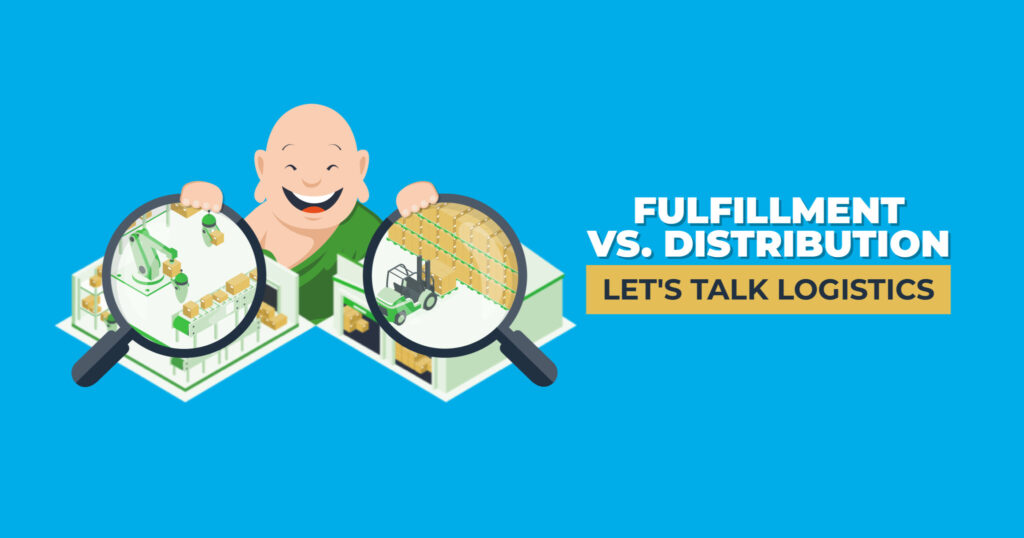
Fulfillment and distribution are two different processes, right? So why do we sometimes use these two words to describe the same building or a company? Is a distribution center the same thing as a fulfillment center? Is distribution logistics the same thing as fulfillment logistics? No, and heck no.
As an all-in-one solution, we at ShipMonk, handle both distribution and fulfillment for ecommerce businesses. When we’re distributing inventory across multiple warehouses, we’re dabbling in distribution logistics. When we’re prepping merchandise for Amazon FBA or shipping cases of merchandise to Target for an ecommerce brand, we’re dealing in wholesale distribution. But first and foremost, we’re fulfillment logistics experts. So, what’s the difference?
Let’s start with a few definitions.

What is a Warehouse?
In simplest terms, a warehouse is a big building that stores stuff for the long term. If you want something moved in or out, you might have to make an appointment and load the truck yourself. Inside, there may be a system for how things are sorted, a few forklifts, and a maintenance crew for moving stuff around, but it’s pretty low tech — unless that warehouse is also a distribution center or fulfillment center. Then it’s much more (and much busier) than a warehouse.

What is a Distribution Center?
A distribution center is a warehouse that stores large quantities of items temporarily, while they’re on their way to somewhere else. Traditionally, distribution centers are networks of warehouses set up by shipping companies, wholesalers, huge consumer brands, and retailers. Goods and packages are stored and moved in and out of distribution centers in large quantities, usually on pallets. The primary purpose of a distribution network is to reduce order lead times and shipping costs for these businesses.
Brands and retailers may temporarily store their products at a regional distribution center so that wholesale/B2B orders can quickly be filled and retail shelves in that region can quickly be restocked. Shipping carriers like FedEx and UPS use the same hub-and-spoke model to aggregate shipments and move mass quantities of freight going to the same general region. When a shipment reaches a distribution center, the contents are unloaded and stored or resorted, according to each pallet’s next (or final) destination and mode of transportation.

Because distribution centers specialize in moving large quantities around, they form close partnerships with freight transportation companies and the retailers and other businesses they service. Technology within their warehouses tends to be limited to freight management, routing platforms, and electronic data interchange (EDI) systems that allow them to quickly process orders and invoices in the retailers’ digital language.
What is a Fulfillment Center?
A fulfillment center is a type of distribution center that specializes in small-parcel, direct-to-consumer (DTC) logistics. Warehouse teams receive goods in bulk, break them down into saleable units, and store them until a customer like you or me places an order for one of those units. To process or “fulfill” the order, they locate the item, pick it from the shelf, pack it, label it, and ship it on the most efficient route to the customer’s address.
Large ecommerce retailers and marketplaces like Amazon and Walmart own their own fulfillment centers. Smaller ecommerce merchants may choose to handle their own fulfillment, or utilize a third-party logistics (3PL) provider that manages DTC fulfillment for multiple brands. A tech-forward 3PL like ShipMonk invests in the infrastructure and technology that helps smaller brands compete with the big guys.
The key difference between a fulfillment center and a distribution center is the size and quantity of orders being processed. While distribution centers may move millions of units at a time, they’re processing relatively few orders and shipping them to just a handful of locations (primarily businesses). Fulfillment centers, on the other hand, are processing thousands of small orders per day, shipping each one to an individual address. The technology, processes, systems, and infrastructure required for ecommerce fulfillment are very different from B2B and retail fulfillment or wholesale distribution.
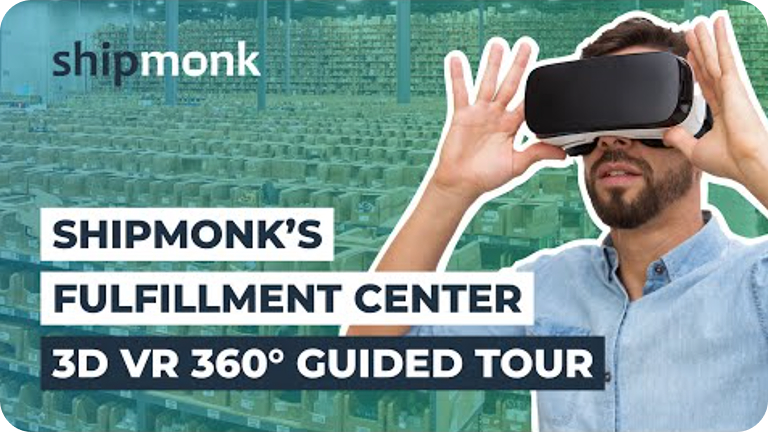
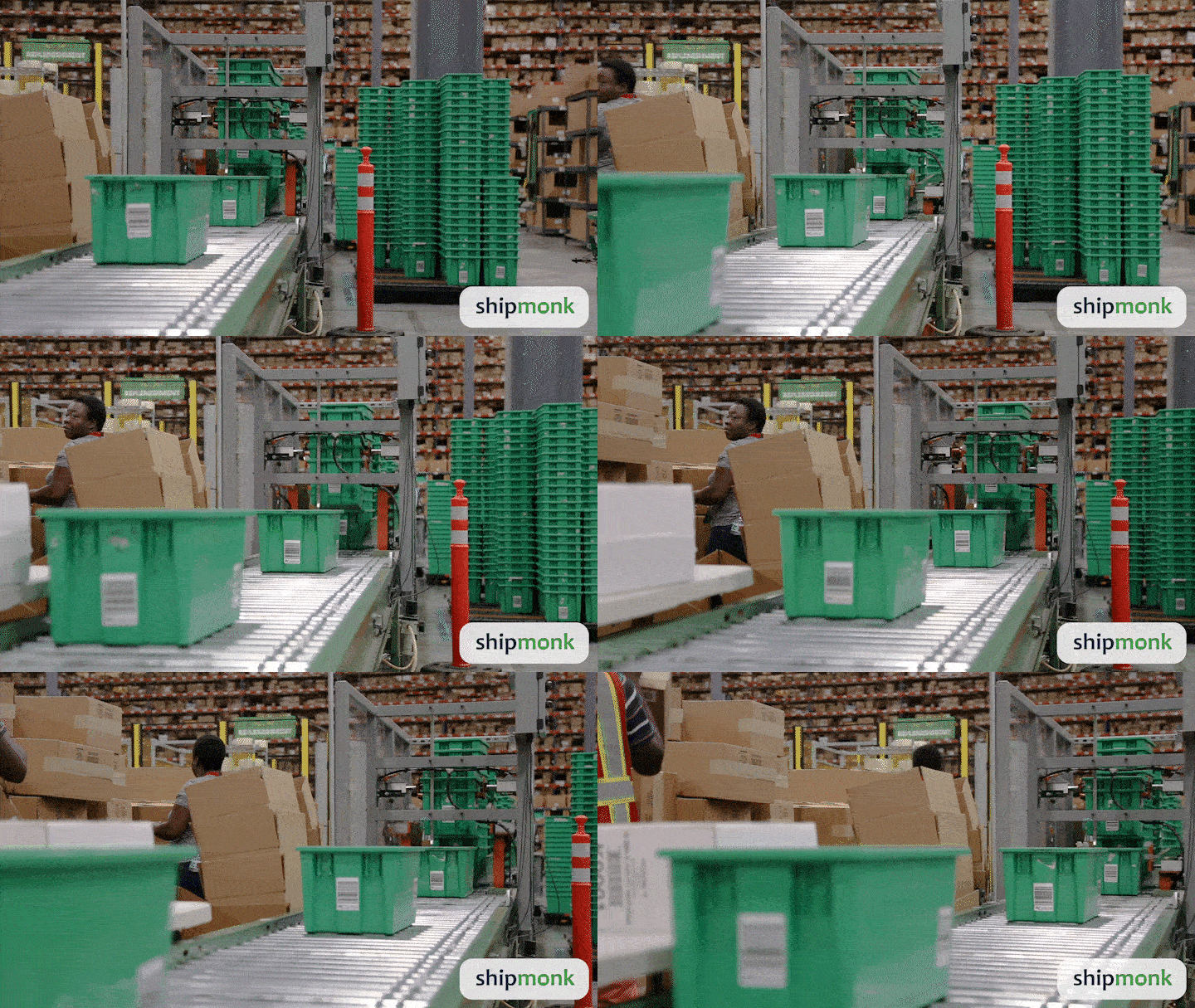
Take a 360 tour of a ShipMonk fulfillment center with the video above! You can see the differences when you walk inside. ShipMonk’s fulfillment centers are constantly in motion. There are conveyor belts, robots, and high-tech automation like sorting, scanning, and retrieval systems, all designed to optimize the pick and pack process. Bins flow from station to station as busy workers fill orders. Behind the scenes, a warehouse management system (WMS) tracks every order and every unit of inventory so the ecommerce sellers can see at a glance where things stand. At the loading dock, global, national, regional and local shipping carriers come and go like clockwork to pick up packages. ShipMonk’s strategic fulfillment center locations and carrier-agnostic routing systems ensure lower shipping rates and last-mile delivery to every address in the U.S.
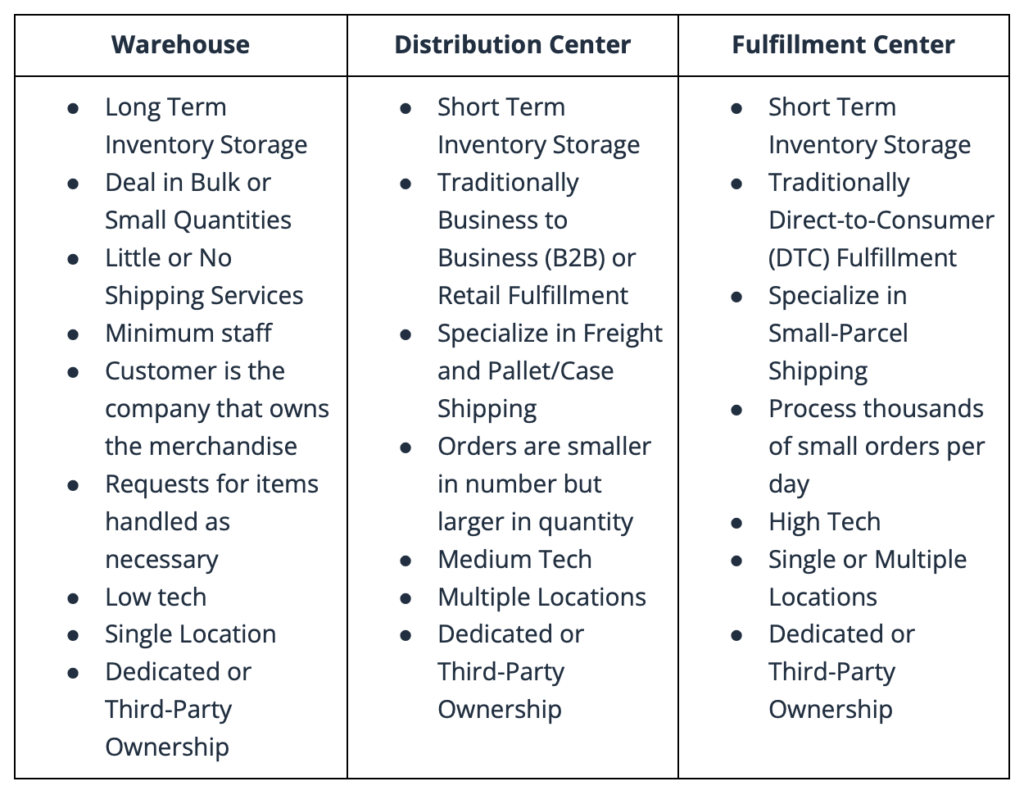
Key Differences Between Warehouses, Distribution Centers & Fulfillment Centers
But What about…?
All that said, there is some overlap to these terms. For example, a tech-enabled fulfillment center (that is, one empowered by automation and technology) may be referred to as a smart warehouse. And smart warehouses can also act as retail distribution centers for omnichannel ecommerce brands that need to combine both DTC and retail/marketplace fulfillment. They may also have multiple fulfillment centers, which enables their ecommerce sellers to distribute inventory across multiple locations, kind of like a distribution center. Yes, it gets a little confusing, but there is a science to managing it all.

What is Logistics?
Logistics is the science of figuring out how to procure, store, and transport goods in the most efficient manner. The term was first used during wartime to describe the mobilization of troops and supplies, but logistics now encompasses the movement of all types of goods, information, money and people. Logistics experts model and analyze networks and the flow of objects, then recommend solutions that organize and control the flow. In the ecommerce world, that means managing the flow of raw materials and finished goods through the supply chain. If that’s not your cup of tea, you can always partner with a 3PL.
As a leading third-party logistics company, ShipMonk strives for efficiency and speed to optimize fulfillment for our ecommerce clients. It’s not just the flow of merchandise, but the flow of information. We create partnerships and integrate technologies that connect many independent entities together: ecommerce storefronts, payment systems, inventory and order management systems, freight and shipping companies, reverse logistics (RMA) providers, and all the helpful third-party apps that enable ecommerce to flow. ShipMonk’s powerful fulfillment software processes orders, tracks shipments, eliminates bottlenecks, makes inventory management easier, and provides real-time data to all stakeholders.
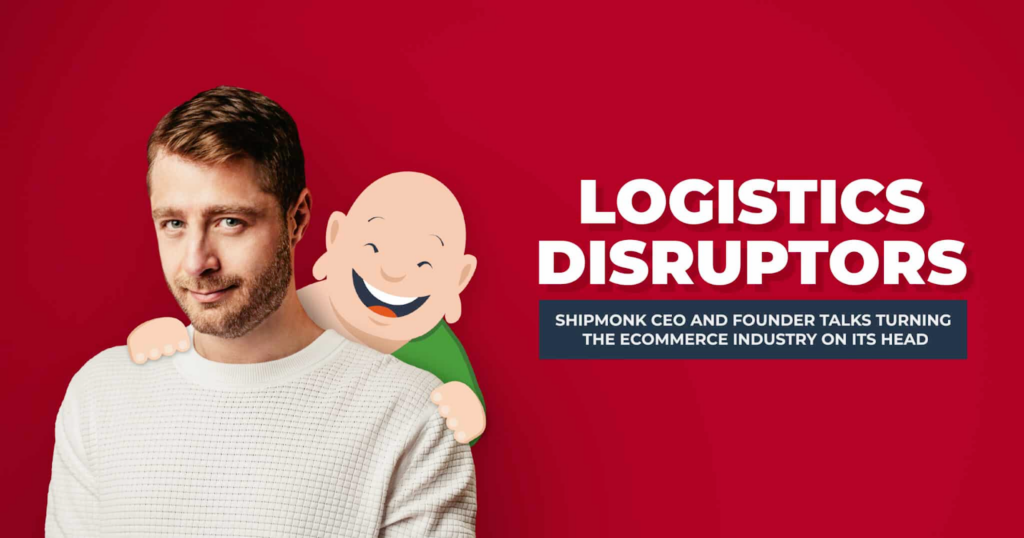
Check out a recent interview where ShipMonk Founder Jan Bednar, renowned logistics disruptor, shares his approach to fulfillment and how ShipMonk drives the evolving ecommerce industry forward.
Different Types of Logistics
Logistics is logistics wherever it’s applied, but you’ll see different terminology depending on what’s flowing and which direction it’s moving. In the ecommerce and retail industries, these are the most commonly mentioned types of logistics.
- Supply Chain Logistics This is the broadest term covering the entire supply chain from shipping raw materials to delivering finished products to customers. Powerful enterprise systems handle this task for large companies, while a single inventory manager might handle this task for a startup.
- Distribution Logistics (a.k.a. wholesale logistics or wholesale distribution) This type of logistics focuses on moving goods closer to the retailers and other businesses that sell or use them in large quantities. The art of distribution logistics is in maintaining sufficient inventory levels in each region to fill demand, while minimizing storage costs and dealing with unpredictable events like pandemics and ships getting stuck in canals.
- Fulfillment Logistics This type of logistics focuses on handling thousands of incoming orders from multiple sales channels, processing orders quickly and accurately through the fulfillment pipeline, and routing and shipping orders to customers’ doorsteps most efficiently. It takes a certain type of person and a lot of software to handle this many moving parts, and here at ShipMonk we have plenty of both.
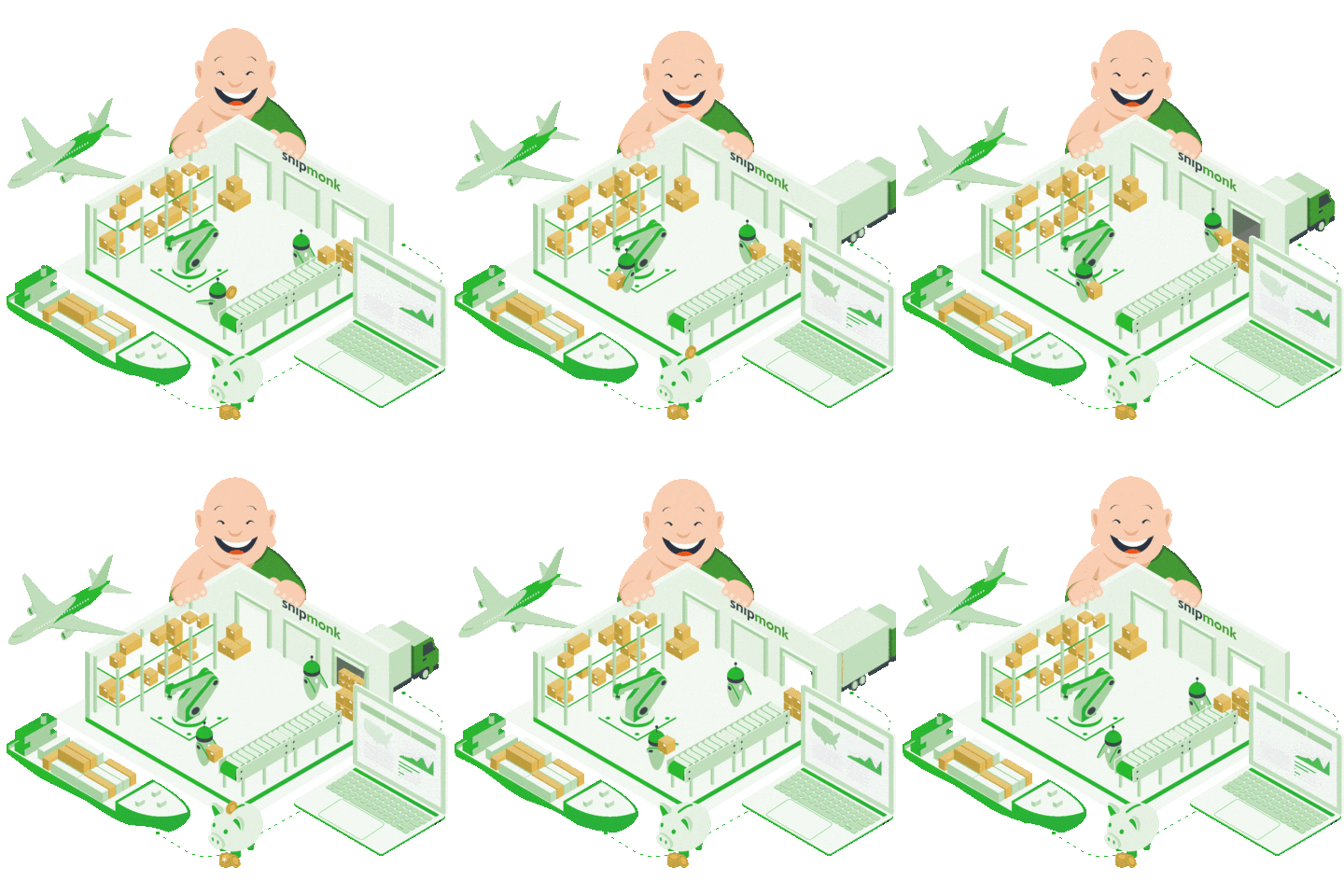
- Reverse Logistics The opposite of fulfillment logistics, reverse logistics focuses on efficiently handling returns for ecommerce businesses. The objective here is to limit losses while retaining loyal customers. Some fulfillment logistics providers (like ShipMonk) also handle reverse logistics.
- Third-party Logistics (3PL) is a service offered by companies who handle logistics for other companies who can’t or don’t want to handle it themselves. There are third party logistics providers that handle distribution logistics (such as DHL and Ryder), and others that handle fulfillment logistics (such as ShipMonk).
- Transportation Logistics This type of logistics is the province of freight carriers and small-parcel shipping companies whose entire business model is moving things from A to B. These companies deal in large shipping containers that move goods by ship or rail, and/or efficiently manage fleets of planes, trucks and delivery vans, while tracking the contents.

What More Do You Need to Know?
We’ve covered the basic differences between distribution and fulfillment logistics, but if you’re still confused, we can help! Let one of our Happiness Engineers take a look at your ecommerce fulfillment needs and see how we can take it to the next level.
Need faster fulfillment? Each of our 12 state-of-the-art fulfillment centers across the US, Canada, Mexico, and Europe, is built for speed and accuracy to help your DTC ecommerce business scale.
Need FBA prep services? We’re well versed in Amazon’s requirements and have prepped millions of units for FBA.
Moving into wholesale? Our B2B fulfillment suite and EDI-compliant technology helps growing brands quickly master the complex challenges of retail distribution and wholesale fulfillment. Contact us to learn more!
Frequently Asked Questions
ShipMonk is a leading third-party logistics (3PL) and technology provider that specializes in omnichannel fulfillment for enterprise brands.
ShipMonk provides end-to-end logistics solutions, including order fulfillment, inventory management, custom packaging, and global shipping software designed to scale enterprise businesses.
ShipMonk leverages proprietary technology and a global warehouse network to reduce shipping costs, improve delivery speeds, and automate the “stress” out of fulfillment.
ShipMonk is a tech-enabled 3PL, combining advanced fulfillment software with a physical infrastructure of automated warehouses to streamline supply chain operations.
The key difference is the type of orders processed. A fulfillment center handles thousands of small, direct-to-consumer (DTC) orders daily, picking, packing, and shipping individual packages. A distribution center moves large quantities of goods—often pallets—to retailers, wholesalers, or regional hubs.
No, a fulfillment center is more advanced than a traditional warehouse. Warehouses primarily store goods long term, while fulfillment centers actively process orders using warehouse management systems, automation, and carrier integrations to pick, pack, and ship products quickly to customers.
Ecommerce businesses use fulfillment centers because they are optimized for high-volume online orders. These facilities combine automated picking systems, inventory tracking software, and shipping carrier networks to process thousands of small-parcel shipments daily, enabling fast and accurate direct-to-consumer delivery.
Logistics refers to the planning and coordination of how goods move through the supply chain—from sourcing and storage to transportation and final delivery. In ecommerce, logistics includes inventory management, fulfillment operations, shipping optimization, and returns processing to ensure efficient product flow.
A third-party logistics provider (3PL) manages logistics operations for ecommerce brands, including inventory storage, order fulfillment, shipping, and sometimes wholesale distribution. Tech-enabled 3PLs like ShipMonk integrate ecommerce platforms, automate warehouse operations, and provide real-time data visibility for scalable growth.
Yes. Many modern fulfillment centers support omnichannel logistics, meaning they can handle direct-to-consumer orders, retail distribution, and Amazon FBA preparation. Providers like ShipMonk use integrated technology and EDI systems to manage both small-parcel ecommerce orders and large retail shipments.