A customer clicks “return.” The label prints. The package ships. And then what? That question lies at the heart of ecommerce returns management.
In short: Ecommerce returns management is the end-to-end process of receiving, inspecting, grading, and dispositioning returned items — deciding whether each one is restocked, reworked, liquidated, donated, or disposed of. For apparel brands, where roughly 25% of online orders come back, how fast and accurately each garment moves through that process determines whether a return recovers value or erodes margin.
For most apparel brands, ecommerce returns management is a black box: a pile of packages that arrives at a warehouse and disappears into a process that costs money, takes time, and rarely gets the strategic attention it deserves. Yet apparel returns run at a 25% average rate online, and some product lines hit 40% or more. That means roughly one in four garments you sell is coming back.
What happens to it when it does? The answer determines whether you recover value, lose margin, or end up with sellable inventory that’s silently eroding on a shelf.
This guide breaks down the full lifecycle of a returned garment, from the moment the box hits the dock to the decision that determines its fate. If you’re an apparel brand trying to get ecommerce returns management right, this is where to start.
Key takeaways
- Apparel returns average about 25% of online orders, and some product lines exceed 40% — roughly one in four garments sold comes back.
- Every returned garment follows the same lifecycle: receiving → inspection → grading → disposition (restock, rework, liquidate, donate, or dispose).
- Approximately 70% of apparel returns are driven by fit or style, so exchange-first policies and accurate product pages prevent many returns before they happen.
- Speed protects value: the average full return cycle runs 9–10 days, and every unprocessed day erodes resale value and inventory accuracy.
Step 1: Ecommerce Returns Management Starts at Receiving — What Happens in the First 60 Minutes
The first thing that happens when a return arrives is receiving: the package is logged into the warehouse management system, scanned, and physically sorted. This sounds simple. It is rarely simple.
In too many warehouses, returns don’t get the same urgency as outbound orders. They pile up on the dock, sometimes for two to three days, before anyone opens a box. By the time the item is touched, the window for quick restocking has already shrunk. The item sits in a processing queue, not in inventory.
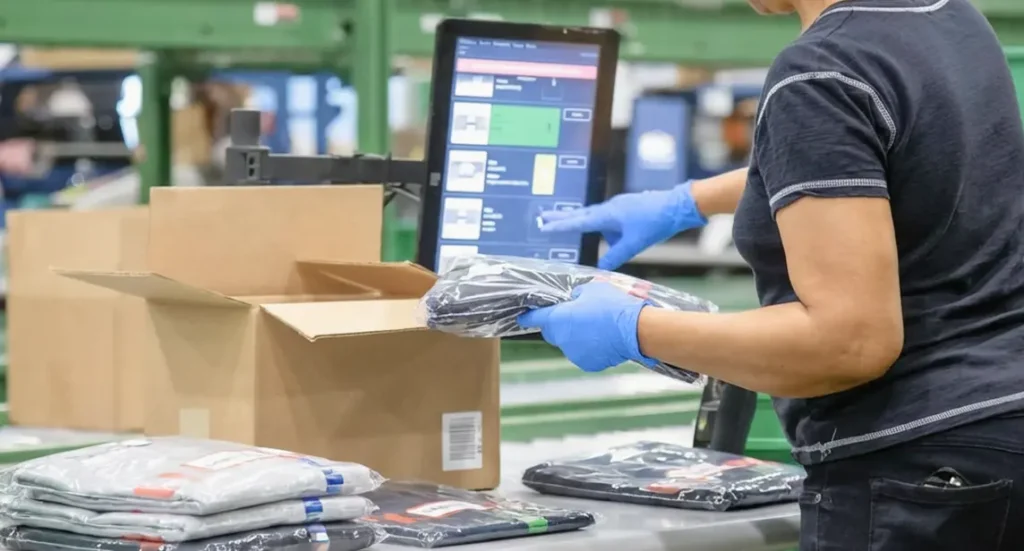
At a well-run 3PL like ShipMonk, this looks different. Arrival status is confirmed automatically as soon as a return enters the system, and every item is photographed at receipt, creating a timestamped record of condition before anyone has opened the packaging. That matters for two reasons: it creates a paper trail for condition disputes, and it forces the process to begin immediately rather than waiting in a pile.
The clock starts at receiving. Every hour a returned garment spends unprocessed is an hour its resale value is at risk and its inventory count is inaccurate.
Step 2: What Determines Whether an Item Can Be Resold?
This is the most consequential decision in the returns process, and it’s made at inspection. Inspection is where a warehouse associate, working from your brand’s specific instructions, evaluates the item and assigns it a disposition.
The standard grading categories are: Sellable (New), Sellable (Open Box), Needs Rework, Damaged, and Dispose/Donate. The criteria that determine which category an item falls into depend on three things:
1. Physical condition. Is there visible damage? Signs of wear? Odor? Staining? For apparel, these checks have to be more subjective than for, say, electronics. A shirt can look fine in a photo but smell like perfume or show lint from wear. A skilled inspector catches this; an undertrained one doesn’t.
2. Packaging integrity. Can the item be resold in its original packaging, or does it need to be rebagged, retagged, or refolded? For apparel, this is almost always a factor. Garments arrive crumpled, with tags removed, or in bags that have been torn open. That doesn’t mean they can’t be resold. It means they require rework.
3. Brand instructions. Your 3PL cannot grade a return correctly without explicit rules from you. What level of wear disqualifies resale? Can items with original tags removed still go back on the shelf? Is there a size-out-of-season rule? Without these instructions in writing, grading becomes inconsistent, which means your inventory data becomes unreliable.
When the inspection is done well and consistently, the result is inventory you can trust. When it’s done poorly, you end up with “sellable” items that generate a second complaint from the next customer who buys them.
Step 3: What Mistakes Do Brands Make With Returns?
Returns problems usually get blamed on the warehouse. Most of the time, the root cause is upstream.
Mistake 1: Treating returns as a cost center instead of an inventory recovery operation. Brands that invest in fast, accurate returns processing recover more sellable units, reduce write-offs, and maintain more accurate inventory positions. Brands that treat returns as a necessary annoyance end up with backlogged dock piles and inventory they can’t trust.
Mistake 2: No documented grading instructions for the 3PL. If your fulfillment partner doesn’t have clear written standards (what counts as “sellable,” what requires rework, what gets disposed), every associate will make their own call. The result is inconsistent grading, inconsistent inventory, and no accountability.
Mistake 3: Not steering customers toward exchanges. Approximately 70% of apparel returns are driven by fit or style. Many of those customers would accept an exchange for a different size if the process made it easy. Brands that default to refund-first policies are converting fixable situations into lost revenue.
Mistake 4: Poor product representation that drives avoidable returns. Inaccurate sizing guidance, misleading photos, and vague material descriptions inflate return rates before a garment ever ships. Solving a returns problem at the warehouse is downstream of a content problem that started on the product page.
Mistake 5: Letting returned inventory sit off-system. When a returned item is physically present in the warehouse but not yet processed through the system, it creates a phantom inventory gap. Customer service may tell buyers an item is available when it isn’t reliably restocked. This creates a second-order problem on top of the original return.
Step 4: What Slows Return Processing Down?
Returns take longer than they should for predictable, fixable reasons.
Manual, paper-based receiving. When returns are logged by hand rather than scanned into a WMS in real time, every step downstream is delayed. There’s no automatic inventory update, no triggered rework workflow, no real-time visibility for the brand.
No photo documentation. Without photos taken at receipt, condition disputes between the brand, the carrier, and the customer are resolved by memory or assumption. Photo-first receiving, like ShipMonk’s Quality Guard process, captures timestamped images automatically and removes the ambiguity.
Understaffed or undertrained inspection teams. Returns require more labor than outbound orders; some estimates put it at two times more. Brands that expect their 3PL to absorb peaks in return volume without dedicated capacity end up with backlogs that can stretch for days.
No clear disposition logic. When a warehouse associate doesn’t know what to do with a borderline item, it sits. The default is to wait for guidance, and guidance doesn’t always come quickly. Clear, documented rules keep items moving.
Fragmented technology. Returns that don’t trigger automatic inventory updates across all sales channels create overselling risk and undermine the accuracy of your stock data. Full-cycle visibility, from label creation to restocked inventory, requires clean integrations between your returns software, WMS, and sales channels.
Step 5: Why Is Apparel Harder Than Other Product Categories?
Most product categories arrive in a consistent condition. A returned book is a book. A returned power cable is a power cable. A returned garment can be almost anything.
The complexity specific to apparel returns comes from several directions:
The SKU structure multiplies errors. Every garment lives inside a size × color × style matrix. When a size medium navy blue shirt gets restocked to the size large black shirt’s SKU (which happens in manual environments), the inventory error goes undetected until the wrong item ships to the next customer.
Condition is harder to standardize. Was the item worn? Has it been washed? Is that a crease from folding or evidence of wear? Apparel inspectors need judgment calls that electronics inspectors don’t. This means consistent training matters more, not less.
Presentation recovery is a separate operation. A returned garment frequently needs steaming, refolding, new poly bagging, and a fresh tag before it’s ready to sell again. This isn’t part of standard outbound fulfillment. It’s a specialized rework process. Facilities that aren’t set up for it either skip these steps (and ship a shabby-looking item to the next customer) or send items to a separate refurb facility (adding days and cost).
ShipMonk handles this inside the fulfillment center: on-site steaming, rebagging, and retagging are part of the apparel returns workflow, which means recovered inventory goes directly back to shelf-ready status without leaving the building.
Seasonality compounds everything. A garment returned three weeks after a season ends has limited resale value in your own store. Brands that don’t have a strategy for off-season returned inventory (whether that’s liquidation, donation, or secondary market) end up warehousing dead stock.
What a Returned Garment Should Look Like at the End
A well-processed return ends in one of four places: back on the active inventory shelf as a sellable unit, routed to a secondary channel (outlet, marketplace, liquidation), donated to a partnered charity, or responsibly disposed of. The worst outcome, and the most common one when returns operations are underfunded, is a sellable garment that sits in a processing backlog, costs money to store, and never makes it back to revenue.
Apparel brands that get this right don’t think of returns as a reverse supply chain problem. They think of them as an inventory recovery operation with a cost-per-unit ceiling. Every garment that comes back either pays its way back into active stock or gets moved to the most value-maximizing exit. Nothing sits.
Turn Ecommerce Returns Management Into a Competitive Advantage With ShipMonk
ShipMonk’s ecommerce returns management platform is purpose-built for apparel brands that can’t afford to treat returns as an afterthought. Every returned item is photographed at arrival, graded against your brand’s specific standards, and either restocked, reworked, or dispositioned, with full inventory visibility at every step.
From on-site steaming and rebagging to automatic inventory updates across all your sales channels, ShipMonk closes the gap between “return arrived” and “back in stock and ready to sell.”
Ready to stop losing money on returns? Talk to ShipMonk’s apparel fulfillment team.
Frequently Asked Questions
Ecommerce returns management is the end-to-end process of receiving, inspecting, grading, and dispositioning returned items, and deciding whether they go back to active inventory, get reworked, or are donated or disposed of. For apparel brands, it matters because return rates average 25% online, meaning poor returns operations directly erode profitability and inventory accuracy.
Apparel and footwear consistently see the highest return rates in ecommerce, around 25% on average, with some categories and product lines exceeding 40%. By comparison, the overall ecommerce return rate is approximately 20%.
When shipping and inspection time are both included, the average full return cycle runs 9 to 10 days. Brands using a 3PL with automated receiving and real-time inventory updates can significantly compress the time between item receipt and inventory restoration.
Items that fail inspection are typically routed to donation partners, liquidation channels, or responsible disposal. An estimated 5 billion pounds of returned goods end up in U.S. landfills each year, a problem that apparel brands with clear disposition workflows and charity partnerships can meaningfully reduce.
Fit is the primary driver. Approximately 70% of apparel returns are caused by sizing, fit, or style issues, problems that better product photography, accurate size guides, and virtual try-on tools can reduce at the source.