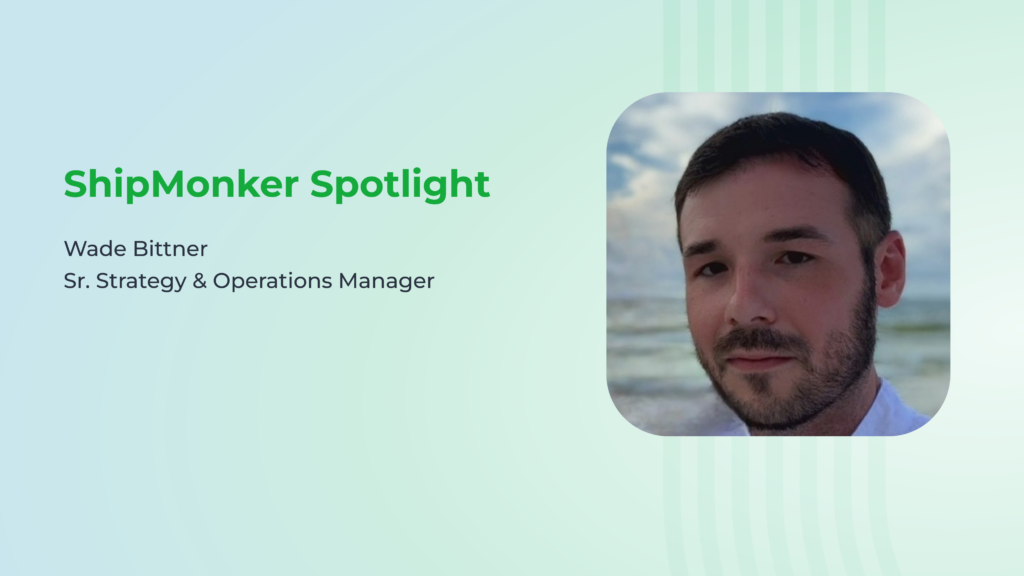
Wade Bittner spent 13 years in retail operations at a Fortune 500 company, ending as a Program Manager. He knew how to build systems. He knew how to drive change in massive organizations. He also knew the cost: the bigger the organization, the more guardrails around actually getting things done.
In June 2024, a former colleague reached out. ShipMonk is different, they said. Come see.
Wade met with our leadership team and what struck him wasn’t just the startup energy. It was startup energy pointed directly at building something better for merchants. That clarity of purpose, combined with the autonomy to actually execute, that’s what sealed it.
He didn’t know then that within months, he’d spot an opportunity in an entirely new domain and step up to own it.
The Balance
Coming from retail operations, Wade’s instinct was to bring every best practice he’d learned from larger, traditional environments. Structure. Process. Discipline.
Then he realized something: that approach would work against the startup energy that makes ShipMonk strong.
“The real skill became finding the balance,” Wade explains. “Building enough structure to run efficiently and keep people informed, while still leaving room for adaptation and innovation.”
That’s harder than it sounds. Too much structure and you slow everything down. Too little and you lose people. The art is knowing which guardrails matter and which ones just get in the way.
Wade found that balance. And it changed how he thinks about his work entirely.
The Claims Opportunity
Early on, Wade spotted something: the claims domain was a place where merchants struggled, where processes weren’t optimized, and where innovation could actually move the needle. He volunteered to take it on.
Now he leads claims, connecting ownership and innovation across services like MonkProtect and standard claims processes. The goal is simple: cut friction and speed up resolution time for merchants.
But the work is sophisticated. It requires understanding the merchant perspective completely. It requires pulling together multiple teams that don’t normally coordinate. It requires refusing to accept “that’s how it’s always been done.”
That’s exactly the kind of problem Wade thrives on.
What Strategy and Operations Actually Does
Most people don’t understand what a strategy and operations team does day to day. It’s not glamorous. It doesn’t show up as a headline.
One day Wade is deep in data. The next he’s aligning three teams on a process. The next he’s untangling a problem that doesn’t have an obvious owner yet. He’s improving efficiencies behind the scenes, overseeing cross-functional projects, tearing down barriers, rolling out processes that connect teams.
The pattern is always the same: improve the merchant experience a little more. Scale the business in a way that actually fits merchants’ needs.
And crucially, keep that focus from staying siloed within one team. Make sure the entire organization orients around that same merchant-first structure, so every domain and team is pulling in the same direction.
When that work is done well, nobody notices the problem it prevented. They just notice that things got better.
Why This Matters
Wade’s journey, from Fortune 500 rigor to startup agility to finding the balance between both, reveals something essential about ShipMonk’s approach to building infrastructure.
We’re not choosing between structure and innovation. We’re choosing both. We’re building the kind of organization where you can maintain discipline and efficiency while still staying nimble enough to adapt. Where you can establish systems without creating barriers.
That requires leaders who’ve seen both worlds and understand the tradeoffs. Leaders who know that the guardrails that work in a Fortune 500 might be exactly what slows you down at a startup. But also that pure startup energy, without any structure, eventually collapses into chaos.
Wade is that kind of leader. He came from an environment where change was constrained. He chose to build in an environment where the constraint is figuring out which changes actually matter most.
That clarity of purpose, merchant first, always, is what lets him build structure without friction.