In retail, growth doesn’t just depend on demand—it depends on connectivity.
Behind every successful wholesale relationship is a complex web of systems exchanging data in real time. Purchase orders, shipment confirmations, invoices, and routing instructions must align perfectly with retailer requirements.
That’s where B2B fulfillment solutions and strong EDI infrastructure become critical.
Without it, even the most promising retail opportunities can stall before they begin.
What Is EDI in B2B Fulfillment?
Electronic Data Interchange (EDI) is the automated exchange of business documents—such as purchase orders, advance shipment notifications (ASNs), and invoices—between brands and retailers.
Instead of manual processes, EDI ensures systems communicate in real time, improving speed and accuracy.
In retail, EDI is required to:
- Process purchase orders
- Send ASNs and shipment updates
- Meet routing and labeling requirements
- Maintain retail EDI compliance
Without reliable EDI integrations, most major retailers cannot be supported at scale.
Why EDI Is Critical for Retail Growth
EDI enables brands to connect, comply, and scale within retail ecosystems.
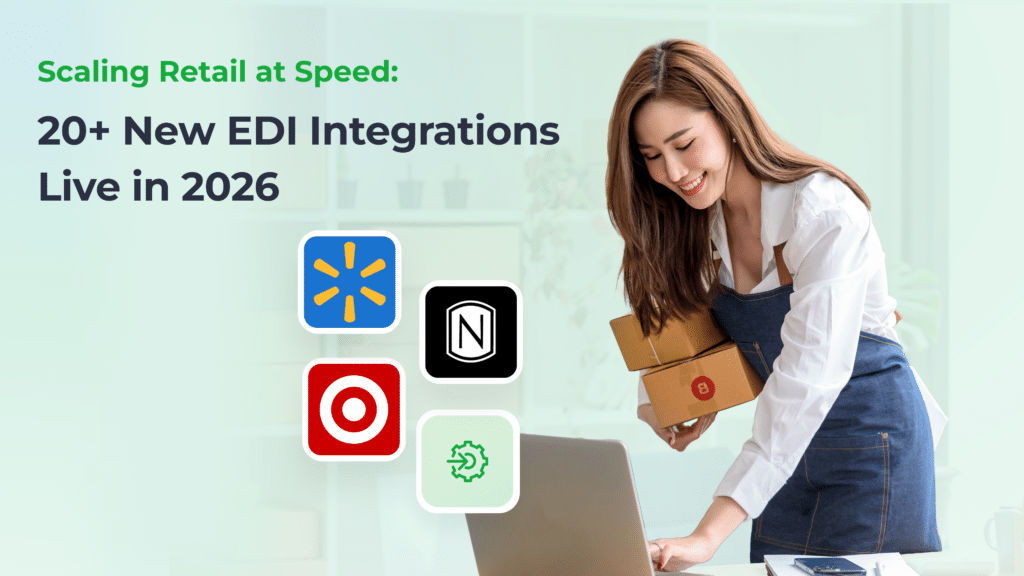
Retailers like Walmart, Target, Nordstrom, Chewy, and CVS require strict adherence to their systems and workflows. Without proper infrastructure, brands risk:
- Delayed shipments
- Chargebacks and compliance penalties
- Failed onboarding processes
A strong EDI foundation removes these barriers and creates a faster, more reliable path into retail.
20+ EDI Integrations Launched in 2026
Since the start of 2026, ShipMonk has launched 20+ EDI and B2B integrations, with more already scheduled.
These integrations support retail fulfillment solutions cross some of the most operationally demanding retailers.
Each integration includes:
- Custom document mapping
- End-to-end workflow testing
- Retailer-specific compliance validation
This isn’t just about volume—it reflects a system designed to scale through repeatable, reliable processes.
Supporting Complex Retail Fulfillment Requirements
Every retailer operates differently. That means every integration must account for unique specifications, workflows, and compliance standards.
ShipMonk supports multiple fulfillment models, including:
- Dropshipping (direct-to-consumer on behalf of retailers)
- Direct-to-distribution center shipping
- Store replenishment
This flexibility allows brands to scale across retail channels without rebuilding operations for each new partner.
How EDI Integrations Reduce Retail Onboarding Time
One of the most common challenges brands face is onboarding new retail partners.
How can brands speed up retail onboarding?
The answer is infrastructure.
With pre-built connections across providers like SPS Commerce, Orderful, and direct APIs, ShipMonk simplifies the retail onboarding process.
Instead of starting from scratch, brands benefit from:
- Standardized workflows
- Faster integration timelines
- Fewer compliance errors
This creates a more predictable path to launching and scaling wholesale operations.
Building a Connected EDI Ecosystem
Not all of these integrations are new—but bringing them together at this scale marks a shift.
Rather than treating integrations as one-off builds, ShipMonk is creating a connected ecosystem.
Each new integration:
- Strengthens the network
- Reduces implementation time for future partners
- Improves consistency across operations
This compounding effect is what enables long-term scalability.
How EDI Supports Omnichannel Fulfillment
As brands expand into retail, they also need to maintain direct-to-consumer operations.
This is where omnichannel fulfillment becomes essential.
With the right EDI infrastructure, brands can:
- Manage B2B and DTC fulfillment in one system
- Support multiple retail channels simultaneously
- Maintain compliance across partners
- Scale without operational bottlenecks
The Future of B2B Fulfillment and EDI
With additional integrations already on the horizon, this momentum continues.
Each new connection strengthens a network designed to support modern retail at scale—giving brands faster access to new opportunities without the traditional friction of EDI complexity.
Because in today’s retail landscape, success isn’t just about where you can sell—it’s about how seamlessly you can connect.
Frequently Asked Questions (FAQs)
EDI (Electronic Data Interchange) is the automated exchange of documents like purchase orders, invoices, and shipment notices between retailers and brands. It enables faster, more accurate communication and is required by most major retailers.
Retailers use EDI to standardize operations, reduce manual errors, and ensure compliance across suppliers. It allows them to process orders, track shipments, and manage inventory efficiently at scale.
EDI onboarding timelines vary by retailer, but without existing infrastructure, it can take weeks or months. Pre-built integrations and standardized workflows can significantly reduce this timeline.
EDI integrations help brands:
-Reduce manual work
-Improve order accuracy
-Avoid compliance penalties
-Scale into retail channels faster
Omnichannel fulfillment is the ability to manage and fulfill orders across multiple sales channels—such as DTC, wholesale, and retail—from a unified system.
Ready to scale into retail without the complexity?