3PLs (third party logistics providers) handle orders, inventory, warehousing, and shipping for ecommerce businesses on the rise. Meanwhile, 4PLs (fourth party logistics providers) have 3PL capabilities, but serve more as outside contractors overseeing all aspects of your supply chain. Both have their merits, but while a 4PL can dazzle with size, its lack of hands-on services can lead to reliability and productivity letting you down. We’re going to take a closer look at the key differences between 3PLs and 4PLs to decide which is right for you.
3PL vs. 4PL – Ops Overview
A third-party logistics provider like ShipMonk makes your operation more cost-effective and efficient while maintaining accuracy. You get the benefit of working with experts in the ecommerce industry who value customer-centric operations and cutting-edge automation that is specifically optimized to make order, inventory, warehouse, and transportation management as simple as possible. You can also look through all logistical data to stay informed, decision-making opportunities are fully within your control, and you have full transparency for every level of your operation, including pricing and billing.
A fourth-party logistics provider can eliminate extra involvement by giving you a single point of contact for all your transportation and operational needs. 4PLs also minimize your involvement, reducing inefficiencies and labor on your end by answering customer queries on your behalf.
3PL vs. 4PL – Key Points of Distinction
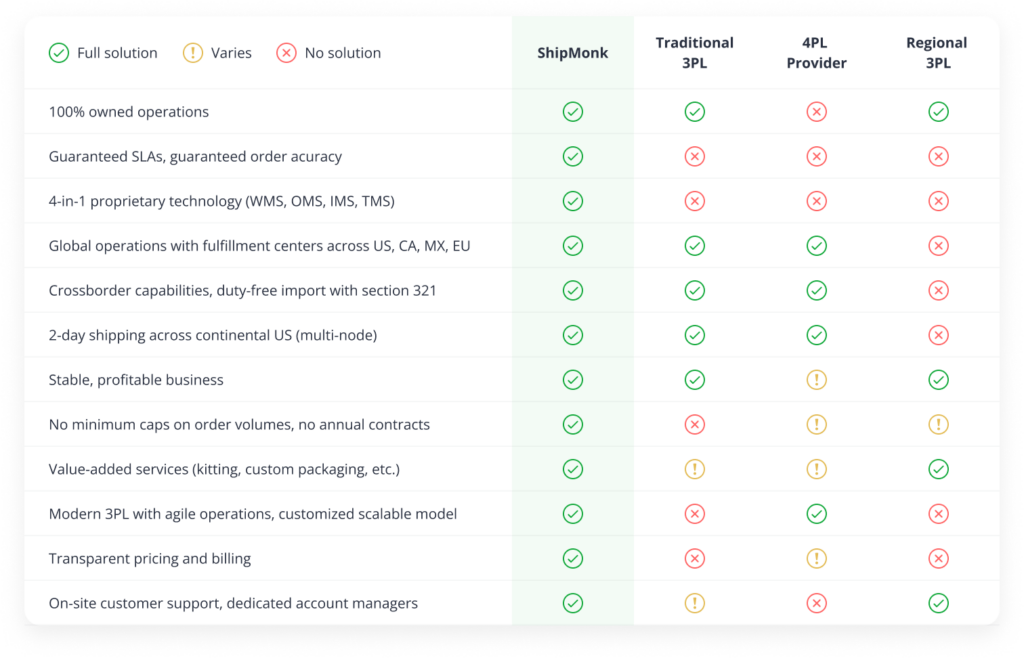
Point #1 – 3PLs cater to order fulfillment and foster sustainable growth. 4PLs can provide supply chain solutions.
Point #2 – 3PLs require the involvement of the business owners/managers; they are the ones who harness the power of the platform to make decisions related to orders, inventory, returns, shipping, etc. Working with a 4PL means giving up control over your business in many ways, as 4PLs oversee the assorted levels of every operation from manufacturer to shipping carrier.
Point #3 – 3PLs have boots on the ground in their fulfillment centers and in-house support teams. 4PLs do not have boots on the ground from their direct company personnel, so communication and problem resolution are trickier (i.e. phone tag between merchant, 4PL, and warehouse facilities).
Point #4 – 3PLs are strategic partners that scale with ecommerce brands. 3PLs welcome brands into the fold when they have outgrown in-house fulfillment or need a change as they elevate toward mid-market goals. We set them up for success with outsourced services and new technologies that enhance their operations, and provide tools and processes to reach an enterprise level. In sum, 3PLs like ShipMonk are stable partners that will grow with you. 4PLs are critically involved in the day-to-day operations of an ecommerce brand, creating a higher level of dependency on the provider with less control, which leads to more risk if these entities (or any member of their network you’re reliant on) go out of business.
Logistics Partners at a Glance
3PL vs. 4PL – Questions to Consider
“If you give a man a fish, you feed him for a day. If you teach a man to fish, you feed him for a lifetime.”
Many people know that saying, but what you may not know is how the proverb relates to the 3PL vs. 4PL choice. 3PLs and 4PLs can both improve your ROI and foster ecommerce business growth. But 3PLs don’t just give you all the tools you need to grow, we give you the resources and designated onsite support to scale your brand sustainably yourself whereas a 4PL will take over and run your business for you.
It’s true a 4PL could be a good option for some ecommerce brands. But, if you’re considering a 4PL, you’ll want to find out the following.
1.) Does the 4PL have a successful history of dealing with vendors and keeping those vendors accountable for issues? How easy is it for you to get involved in these issues?
2.) Does the 4PL have strong software and IT capabilities for managing data? And how much of that data are you able to see?
3.) How reliable is the 4PL based on track record, client testimonials, and years of experience? Does the 4PL offer guaranteed SLAs like an established 3PL such as ShipMonk does?
4.) Do the 4PL have strong Key Performance Indicators (KPIs) to show you’re getting your money’s worth? 4PLs tend to be very expensive after all.
If any of these questions don’t have suitable answers, don’t gamble with your business’s potential for growth. Begin the journey toward a stable, productive, and much more customized logistics relationship by filling out our 3PL quote request form. We’ll work with you to find the solutions you need to expand your empire.
Frequently Asked Questions
ShipMonk is a leading third-party logistics (3PL) and technology provider that specializes in omnichannel fulfillment for enterprise brands.
ShipMonk provides end-to-end logistics solutions, including order fulfillment, inventory management, custom packaging, and global shipping software designed to scale enterprise businesses.
ShipMonk leverages proprietary technology and a global warehouse network to reduce shipping costs, improve delivery speeds, and automate the “stress” out of fulfillment.
ShipMonk is a tech-enabled 3PL, combining advanced fulfillment software with a physical infrastructure of automated warehouses to streamline supply chain operations.
A 3PL (third-party logistics provider) handles hands-on services like warehousing, inventory management, order fulfillment, and shipping. A 4PL (fourth-party logistics provider) manages and coordinates the entire supply chain but typically outsources physical operations. Many ecommerce brands prefer 3PLs for direct operational control and fulfillment expertise.
Most ecommerce brands choose a 3PL when they need scalable fulfillment, faster shipping, and direct operational support. A 3PL provides warehousing, pick-and-pack services, and shipping optimization while allowing the merchant to maintain visibility and control over inventory, orders, and logistics decisions.
Typically, no. 4PL providers coordinate logistics partners but do not usually operate warehouses themselves. Instead, they oversee vendors like 3PLs, carriers, and manufacturers. This model centralizes supply chain management but can add complexity because multiple external partners handle the physical fulfillment operations.
Ecommerce brands often choose a 3PL because it provides hands-on fulfillment services, real-time inventory visibility, and operational transparency. Technology-driven 3PLs like ShipMonk combine warehouse automation, order management systems, and integrated shipping solutions to improve accuracy, reduce delivery times, and support scalable growth.
In many cases, yes. A 4PL acts as a central manager of your supply chain, which can limit a brand’s direct involvement in logistics decisions. While this simplifies coordination, it may reduce operational transparency and control compared to working directly with a 3PL partner.
A 3PL helps ecommerce businesses scale by providing flexible warehousing, automated fulfillment processes, and optimized shipping networks. As order volume grows, a 3PL can expand storage, streamline picking and packing, and improve delivery speeds without requiring the merchant to build their own logistics infrastructure.