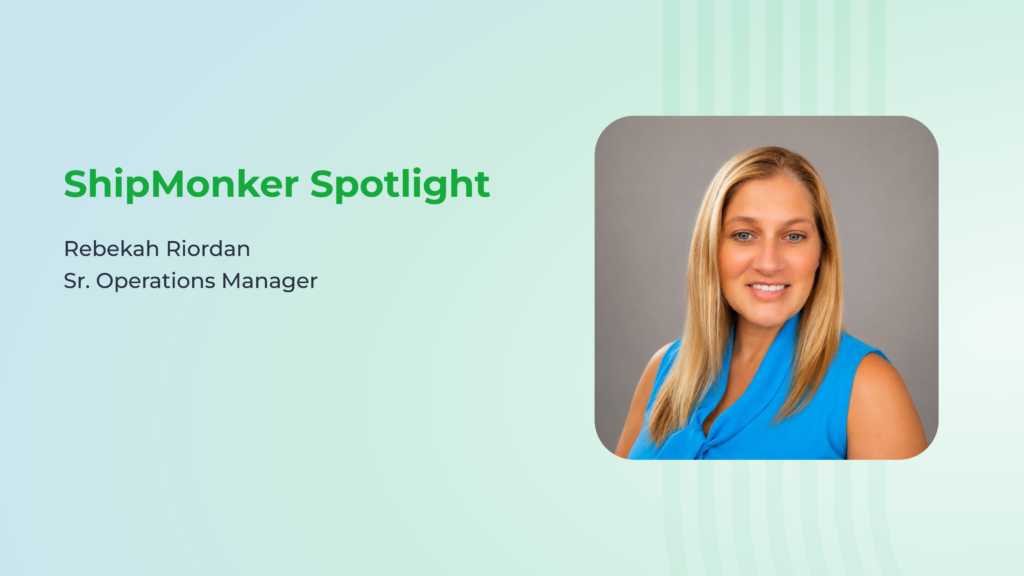
Rebekah joined ShipMonk in 2022 as an Inbound Supervisor. It was a straightforward role in operations—lead the team, solve problems, keep things moving.
What she didn’t know was that she was about to learn what separates managers from strategic leaders.
From Solving Problems to Preventing Them
In her first few years, Rebekah grew from Inbound Supervisor to Operations Manager to Senior Operations Manager. Each promotion brought bigger scope, more responsibility, more problems to solve.
But something was shifting in how she approached the work.
“I was surrounded by some of the smartest people in the industry,” Rebekah explains. “That taught me to look beyond the immediate problem and see the bigger picture. I started to approach challenges with a stronger focus on long-term improvement, developing others, and helping teams understand how their work connects to the overall operation.”
That’s a subtle but fundamental shift. Most managers solve problems as they arise. Strategic leaders prevent them from arising in the first place. Most managers own their area. Leaders understand how their area affects the whole.
Rebekah made that transition. And ShipMonk noticed.
The Invisible Work
Here’s what most people don’t understand about operations: it looks seamless until it breaks. A schedule that runs perfectly. Orders flowing smoothly. Teams moving with purpose. It all looks easy.
It’s not.
“Operations does not run smoothly because of luck,” Rebekah says. “When everything looks easy, it’s because a great deal of planning, problem-solving, and teamwork has happened behind the scenes. Achieving sustainable results requires investing in the long game. It takes grit, consistency, and a willingness to keep going when the work feels more like a marathon than a sprint.”
That’s the real work of operations. Not the visible execution. The invisible foundation. The systems thinking. The continuous improvement mindset. The willingness to keep iterating when the immediate result isn’t visible.
Most companies know this intellectually. Few actually build cultures where people do it.
The New Role
At the end of August, Rebekah is stepping into a new position: the first Site Continuous Improvement and Change Management Senior Operations Manager for KY2, ShipMonk’s new fulfillment center in Louisville designed specifically for apparel brands.
This isn’t just a new site. It’s a purpose-built innovation hub for apparel fulfillment—designed around the unique complexity of the category, from high-SKU density to specialized returns processing to on-site customization. It’s cutting-edge from day one.
And Rebekah is leading continuous improvement from the ground up.
The role itself signals a shift in how ShipMonk thinks about operations. As the company scales complex facilities, continuous improvement and change management become strategic functions, not operational afterthoughts. They require dedicated leadership—someone who can anticipate challenges, prevent problems before they cascade, and ensure that growth doesn’t compromise the excellence that defines the operation.
Rebekah earned this responsibility through years of evolution. She’s proven she can think beyond the immediate. She understands that the best operations are built through relentless, incremental improvement. She’s someone who thrives when the work is complex and the stakes are high.
What Learning Actually Looks Like
Rebekah’s journey reveals something important about ShipMonk’s approach to development. We don’t promote people into roles they’re already prepared for. We promote them into challenges that stretch them.
“The learning, development, and support I have received from ShipMonk has been life-changing,” Rebekah reflects. “If someone had told me 20 years ago that I would be where I am today, I probably would not have believed them. I am incredibly grateful for the journey and excited about what comes next.”
That kind of trajectory—from supervisor to strategic leader—doesn’t happen in companies that optimize for short-term execution. It only happens when leaders invest in people’s growth, when organizations create space for people to learn from mistakes, and when there’s genuine belief that people can become more than they thought possible.
Rebekah had those conditions at ShipMonk. And she did the work to earn it.
What This Means
Rebekah’s new role signals something about where ShipMonk is heading. As we scale, continuous improvement and change management become strategic capabilities, not just operational practices. We need dedicated leaders thinking about how we improve systems, how we manage transitions, how we make sure growth doesn’t compromise the foundation we’ve built.
Rebekah earned that responsibility through years of learning, evolution, and a willingness to keep going when the work felt like a marathon. That’s exactly the person you want leading continuous improvement.