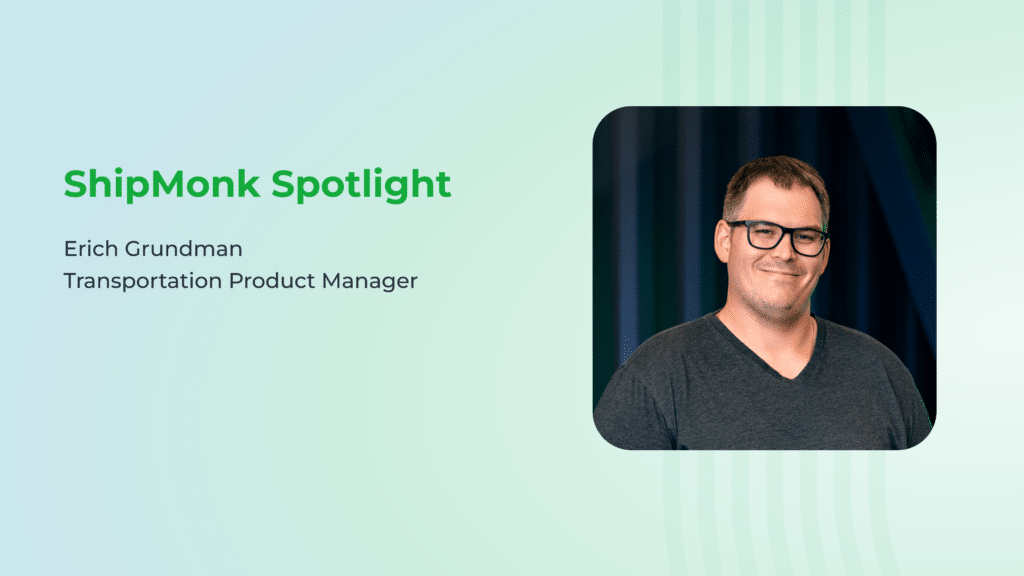
At ShipMonk, we don’t hire people into fixed roles. We hire problem-solvers and give them room to follow the problems that matter. Erich is the best example of what that looks like.
In 2018, Erich joined as a Happiness Engineer. Back then, the role meant account management, customer service, onboarding, and project management all in one seat. It was messy. It was unglamorous. And it revealed something fundamental about how Erich thinks: when something is confusing or broken, dig until you understand why. Then fix it.
That instinct never changed. But the scale of the problems kept growing.
From Output to Leverage
Early in his career at ShipMonk, Erich measured himself the way most people do: by how much work he personally produced. He’d spend two days deep in data to answer one question, feeling productive because he was busy.
That’s a trap. And Erich learned it the hard way.
“The leverage isn’t in producing the answer yourself,” he explains. “It’s in aiming the whole team’s firepower at the questions that actually matter.”
That shift changed everything. Instead of being the person who knew all the answers, Erich became the person who asked the sharpest questions. He stopped trying to be the expert on everything and started pointing the right people and the right tools at the right problem. He learned to pressure-test what came back. He developed the ability to spot when a number was lying to him.
When you make that shift from individual output to orchestrated leverage, the amount you can move stops looking anything like it used to.
“The leverage isn’t in producing the answer yourself. It’s in aiming the whole team’s firepower at the questions that actually matter. In transportation, that means solving for what everyone thinks is impossible: cost and experience together. A merchant’s orders arrive on time at a price that helps them compete. That’s the whole job.”
Following the Problem
Erich’s career at ShipMonk doesn’t follow a traditional path. From Happiness Engineer to Manager to Business Operations to Product Marketing to Operations Analytics to Product Manager for Shipping & Transportation.
On paper, it looks scattered. In reality, it’s relentless focus on wherever the next hard problem was.
He owned data and metrics for the Happiness team. He helped integrate the Mexico acquisition. He shaped the language around what makes ShipMonk different. He ran operations analytics. Each step was a different function, but the underlying work was always the same: take the problem nobody else has untangled yet and turn it into a decision the business can bet on.
That’s not a career path you can plan. It’s a career you can only follow if your company actually lets you.
Solving for Both
Today, Erich leads Product for Shipping & Transportation. It’s a role that reveals his entire philosophy in one challenge: how do you deliver cost and experience together when everyone assumes you have to choose?
“A merchant’s orders arrive on time at a price that helps them compete,” Erich says. “Finding the decision that delivers both, when everyone assumes you have to pick one, is the whole job.”
That’s not a technical problem. That’s not a product problem. It’s a thinking problem. It requires understanding what merchants actually need, what carriers can deliver, what markets will pay for, and how all those constraints actually interact.
It requires the kind of leverage Erich learned to build: a team that understands the problem deeply and can pressure-test solutions from every angle.
Why People Grow Here
Erich’s story—eight years, five function changes, every role one step harder than the last—reveals something essential about ShipMonk’s culture.
We created a place where if you put in the work and earn it, you get handed the next hard thing and the room to go figure it out. We don’t require you to optimize for a job title. We let you follow the problem.
That’s rare. Most companies structure careers as ladders within functions. Head of customer success, then VP of customer success, then Chief Customer Officer. Clear path. Predictable growth.
But that only works if the problems you’re solving stay the same. At ShipMonk, they don’t. We’re scaling. We’re acquiring. We’re building new capabilities. The hard problems keep moving.
Erich didn’t climb a ladder. He followed the problems wherever they led. And because our leaders gave him the room to do that—because they created a culture where that’s possible—he’s now solving some of the most important problems the company faces.
What His Story Says About Us
When Erich started in 2018, ShipMonk was much smaller. The role he filled had to be many roles because there weren’t enough people to specialize. That forced people to think in systems, to understand how pieces connected.
As we’ve grown, we could have siloed. We could have said, “Stay in your function. Do your job.”
Instead, we did something different. We kept the ethos. If you’re good at untangling problems, we’ll give you harder ones. If you can create leverage, we’ll give you more people to leverage. If you can move the business, we’ll clear the path.
That’s not true everywhere. It’s true here. And Erich is proof of what’s possible when a company actually means it.